Beyond Tasting Notes: How Serious Silk Buyers Are Building a Language the Industry Has Never Had
When a master sommelier describes a Burgundy as possessing "crushed violet on the mid-palate with a finish of graphite and dried cherry," the room understands. The vocabulary is codified, the references are shared, and the communication is precise. Now consider what happens when a luxury fashion designer in New York attempts to convey to a mill in Suzhou exactly why last season's charmeuse felt slightly wrong—too cold in the hand, perhaps, or lacking a certain luminous depth. The conversation almost invariably collapses into approximation.
This is the central problem facing the silk industry's most discerning buyers. The sensory experience of premium silk is extraordinarily rich, yet the professional language available to describe it remains, by most accounts, embarrassingly thin.
Why Wine's Model Doesn't Translate
The temptation to borrow from the sommelier's playbook is understandable. Wine culture spent decades—and considerable academic energy—constructing a standardized sensory lexicon. The Wine Aroma Wheel, developed by UC Davis researcher Ann Noble in the 1980s, gave professionals and enthusiasts alike a common map for gustatory experience. Silk has no equivalent.
The fundamental reason is sensory channel. Flavor and aroma, however complex, travel through physiological pathways that lend themselves to comparative description. We taste a wine and instinctively reach for food analogies—fruit, earth, wood—because our palate is already calibrated to those references. Tactile and visual experience operates differently. The way a silk charmeuse drapes across the wrist, the particular angle at which a satin catches light, the subtle resistance of a habotai against the fingertip—these sensations have no equivalent "wheel" to anchor them.
Attempts to import wine language wholesale into fabric discourse have produced results ranging from the poetic to the absurd. Describing a silk organza as "crisp with mineral undertones" may evoke something genuine for the person speaking, but it communicates almost nothing actionable to a mill production manager or a pattern-making team.
What Expert Buyers Are Using Instead
In the absence of an industry standard, a working vocabulary has emerged organically among the most experienced luxury fabric buyers, independent designers, and textile consultants operating in the American market. It is not yet uniform, but its contours are becoming recognizable.
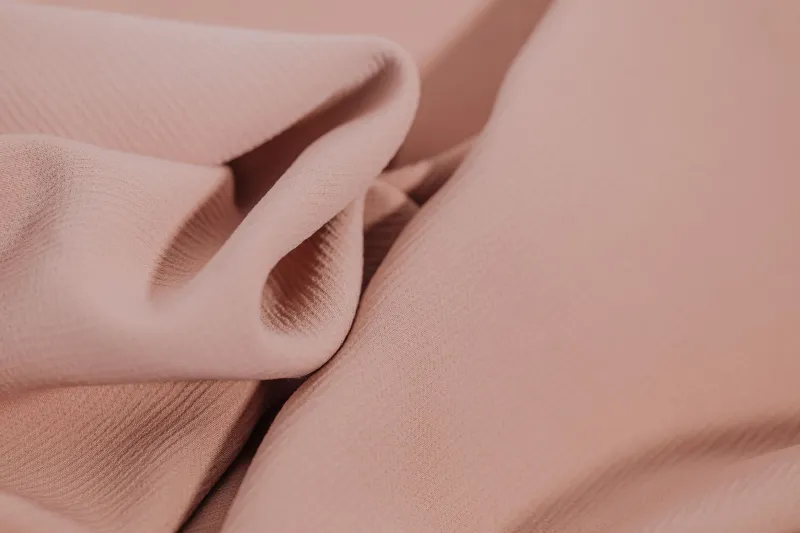
Drape-speak is perhaps the most developed corner of this informal lexicon. Buyers have begun distinguishing between what some call "liquid drape"—the fluid, gravity-led fall of a heavy crepe de chine or a 30-momme charmeuse—and "structured drape," the more architectural behavior of a dupioni or a raw silk twill. Further refinements include "recovery drape" (how a fabric returns to its natural fall after being gathered or bunched) and "memory drape" (whether a silk holds a fold or releases it). These distinctions matter enormously to a designer constructing a bias-cut gown versus one building a tailored jacket.
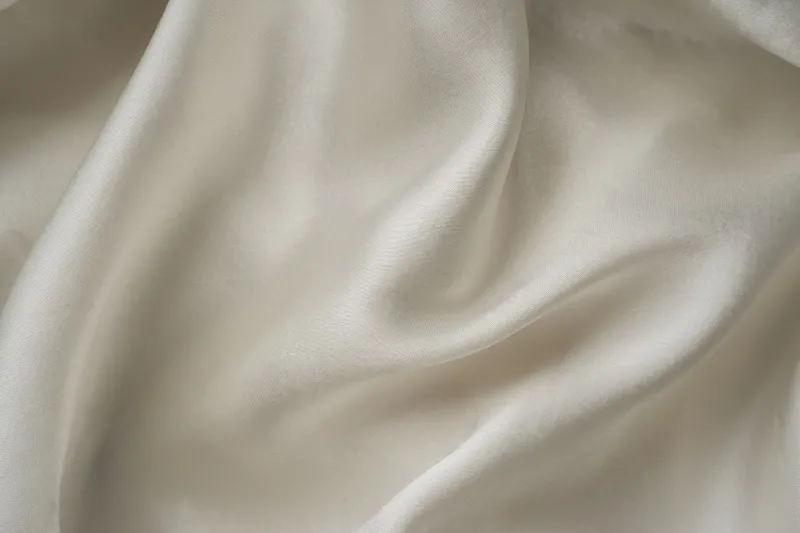
Luster scales represent another area of emerging consensus. Rather than the vague "shiny" or "matte" descriptors that dominate retail copy, serious buyers are beginning to speak in terms of luster directionality—whether a fabric's sheen shifts with movement, as in a satin-weave silk, or remains relatively static, as in a plain-weave habotai. Some buyers have adopted a rough three-tier framework: ambient luster (visible under diffuse light), directional luster (activated by a single light source), and kinetic luster (most apparent during movement). This last category is particularly prized in eveningwear applications and is surprisingly difficult to evaluate from a static swatch.
Hand-feel terminology is the most contested territory. The Japanese textile industry has long employed a formalized system called KES (Kawabata Evaluation System) that quantifies fabric hand through mechanical measurements—tensile strength, bending rigidity, surface friction, compression. While KES data is available for many commercial silk grades, it remains largely inaccessible and opaque to the independent designer or boutique buyer who is making decisions by touch rather than by instrument. In response, American buyers have been developing experiential shorthand: "warm hand" versus "cool hand" (referring to how quickly the fabric seems to absorb or release body heat), "resistance hand" (a slight pushback against the fingers, common in tightly woven silks), and "slip hand" (the almost frictionless quality of the finest charmeuse and satin).
The Swatch Problem
Any honest discussion of fabric communication must confront what industry insiders sometimes call the swatch problem. A two-inch cutting mailed from a mill in Lyon or Hangzhou is a deeply imperfect ambassador for the full bolt. Luster behavior changes at scale. Drape is impossible to assess from a sample the size of a business card. Hand-feel can be affected by the cutting process itself, the handling during shipping, or the residual finishing chemicals that burn off only after the first wash.
This is why experienced buyers have increasingly insisted on what they call "yardage trials"—ordering a minimum of two to three yards of any new silk before committing to a production run. The cost is not insignificant, but it is widely regarded as non-negotiable by those who have been burned by swatch-to-bolt discrepancies. At First Silk, this principle informs how we present our fabrics to designers: swatches are a starting point, never a conclusion.
The Case for a Shared Lexicon
The stakes of imprecise fabric communication extend well beyond individual transactions. When a designer cannot accurately convey what she needs, mills default to their most commercially reliable interpretations. When buyers cannot articulate why a silk feels wrong, quality complaints become vague and unactionable. The entire feedback loop between American designers and international producers degrades.
There is a broader cultural argument as well. The sommelier's vocabulary elevated wine from a commodity to a subject of serious study and connoisseurship. A more rigorous language for silk would accomplish something similar—transforming what is often treated as a purchasing decision into an act of genuine textile literacy. For a material with a history spanning more than five thousand years, that elevation is long overdue.
Some industry observers have proposed that a consortium of luxury textile retailers, independent designers, and academic textile programs collaborate to produce something analogous to the wine world's standardized evaluation tools—a tactile and visual framework that could be taught in design schools, referenced in mill communications, and used by buyers to document their own sensory libraries over time.
Developing Your Own Vocabulary
For designers who cannot wait for an industry-wide solution, the most practical advice is to begin building a personal reference archive immediately. This means keeping meticulous notes alongside fabric samples—not merely recording weight and weave, but documenting hand-feel observations, luster behavior under specific lighting conditions, and drape characteristics at different scales. Over time, these notes become a private lexicon, calibrated to your own sensory experience and increasingly useful when communicating with suppliers.
The goal is not to replace objective measurement—momme weight, thread count, and weave structure remain essential—but to supplement it with the kind of qualitative precision that separates an experienced fabric buyer from a novice. The sommelier's tasting note may not translate directly to textile work, but the underlying discipline—the commitment to articulate what the senses perceive—is entirely worth emulating.
Silk deserves a language as complex as it is. The work of building that language has already begun.