Beyond the Dry Cleaner: Modern Methods for Preserving Your Most Treasured Silk Pieces
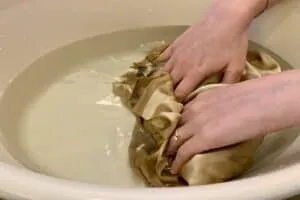
Photo: woman gently hand washing silk fabric in white basin luxury laundry care, via silkpedia.com
For decades, the care label instruction "Dry Clean Only" has functioned as a kind of shorthand for seriousness — a signal that a garment is too precious for ordinary handling. Silk, with its luminous drape and delicate protein structure, has been particularly subject to this convention. Yet a growing body of evidence, drawn from textile conservation science and the practical wisdom of seasoned fashion professionals, suggests that routine dry cleaning may be doing more harm than good to the very pieces it is meant to safeguard.
At First Silk, where fine fabric is not merely a product but a commitment, understanding how to properly care for luxury textiles is inseparable from the act of selecting them. A silk charmeuse blouse or a hand-woven dupioni panel represents a genuine investment — in craft, in heritage, and in personal expression. It deserves a care regimen equal to that investment.
The Chemistry Behind the Concern
Traditional dry cleaning relies on chemical solvents, most commonly perchloroethylene (commonly called "perc"), to dissolve oils and organic matter without introducing water to a fabric. For certain sturdy materials, this process is relatively benign. For silk, however, the calculus is more complicated.
Silk is composed of fibroin, a protein fiber that is inherently sensitive to harsh chemical environments. Repeated exposure to perc and similar solvents can strip the natural sericin coating that gives silk its characteristic luster and hand. Over time, fibers may grow brittle, colors can shift or fade, and the characteristic soft sheen that distinguishes genuine silk from lesser substitutes begins to dull. Textile conservators at institutions including the Smithsonian's National Museum of American History have long noted that frequency of dry cleaning is among the leading contributors to accelerated fiber degradation in historic silk garments.
The environmental dimension compounds the concern. Perc is classified as a probable human carcinogen by the Environmental Protection Agency, and its disposal presents ongoing regulatory challenges for dry cleaning establishments across the United States.
The Case for Careful Hand Washing
For many silk weights and weaves — particularly those in the 8 to 19 momme range commonly used in blouses, linings, and scarves — hand washing performed correctly is not merely acceptable. It is, according to many conservators, preferable.
The operative phrase, of course, is "performed correctly." The following principles define that standard:
Water temperature matters enormously. Lukewarm water, ideally between 68°F and 77°F, is the appropriate range. Hot water causes protein fibers to contract and can permanently alter the drape of a finished garment.
Detergent selection is non-negotiable. A pH-neutral, enzyme-free cleanser formulated specifically for delicate or protein-based fibers is essential. Several American brands, including The Laundress and Eucalan, have developed products well suited to silk. Standard laundry detergents, even those marketed as "gentle," frequently contain enzymes designed to break down protein stains — which means they will, given time, break down silk itself.
Mechanical agitation is the enemy. Silk should be submerged, gently swirled, and allowed to soak for no more than three to five minutes. Wringing, scrubbing, or vigorous movement distorts the weave structure and can cause irreversible stretching or pilling.
Rinsing completely is as important as washing. Detergent residue left in silk fibers attracts particulate matter and accelerates yellowing. Two to three gentle rinses in clean, cool water are typically sufficient.
Emerging Technologies: Professional Wet Cleaning
For pieces that genuinely require professional attention — heavily structured garments, items with elaborate embellishment, or silks that have sustained significant soiling — a newer category of professional service deserves consideration: wet cleaning.
Professional wet cleaning, which has gained substantial ground in American urban markets over the past decade, uses computer-controlled washing equipment, biodegradable detergents, and precisely calibrated drying and finishing processes to clean delicate textiles without chemical solvents. The Wet Cleaning Institute estimates that the technique is appropriate for approximately 90 percent of garments traditionally sent to dry cleaners, including most silks.
From a fabric longevity standpoint, the results are compelling. Studies conducted by the Center for Environmental Research and Technology at the University of California, Riverside, found that wet cleaning preserved fiber integrity comparably or superiorly to solvent-based methods for protein fibers, while producing no hazardous chemical waste. For the discerning consumer who views their silk wardrobe as a long-term investment, locating a certified wet cleaning provider is well worth the effort.
Storage: The Overlooked Dimension of Silk Care
Even the most meticulous washing regimen cannot compensate for poor storage practices. Silk is photosensitive — prolonged exposure to direct light, including fluorescent light commonly found in closets, causes color degradation and fiber weakening. Storing silk garments in breathable cotton or muslin garment bags, rather than plastic, allows air circulation while blocking light and dust.
For folded silk textiles — lengths of fabric, scarves, or flat goods — acid-free tissue paper between layers prevents color transfer and reduces crease stress on individual fibers. Climate control matters as well: silk performs best in environments maintained between 60°F and 75°F with moderate humidity, conditions that approximate the stable environments used in museum textile storage.
Cedar blocks or lavender sachets offer natural pest deterrence without the chemical residue associated with conventional mothballs, which can discolor silk and leave a persistent odor that is notoriously difficult to remove.
Listening to the Fabric Itself
Perhaps the most important shift in modern silk care philosophy is a move away from rigid, universal rules and toward attentive, fabric-specific judgment. A 40-momme silk satin behaves differently from a 6-momme chiffon. A piece dyed with natural indigo requires different handling than one treated with reactive synthetic dyes. A vintage charmeuse with compromised seams demands more caution than a newly cut length of habotai.
At First Silk, every fabric we offer comes with detailed composition and weight information precisely because that specificity enables better decisions — not only in design and construction, but in the ongoing stewardship of finished pieces. Understanding what a fabric is made of, how it was finished, and what it has already endured is the foundation of intelligent care.
Luxury silk is not fragile in the way that fragility implies weakness. It is, rather, responsive — to temperature, to chemistry, to handling, to storage conditions. Treated with the knowledge and attention it merits, a fine silk garment can remain as compelling in twenty years as it was the day it was first worn. That durability is not incidental to luxury. It is, in the deepest sense, what luxury means.