Homegrown Luxury: How American Silk Farmers Are Rewriting the Origin Story
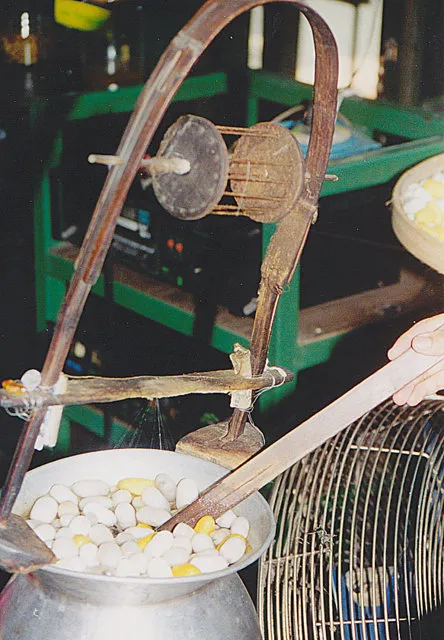
Photo: Peter van der Sluijs, CC BY-SA 3.0, via Wikimedia Commons
Ask most Americans where their silk comes from, and the honest answer is: they have no idea. China supplies the overwhelming majority of the world's raw silk — roughly 70 to 80 percent by most industry estimates — with India and a handful of other Asian nations accounting for much of the remainder. The United States, once home to a modest but genuine silk industry in the 18th and 19th centuries, has been largely absent from the global silk supply chain for well over a hundred years.
That absence, it turns out, is not permanent.
Across the country — from the mid-Atlantic to the Pacific Northwest, from small family farms in Tennessee to research operations in California — a loose constellation of producers, researchers, and textile entrepreneurs is quietly rebuilding something the American market has not had in living memory: domestically produced silk, grown and processed on American soil.
A History Worth Recovering
The American silk story did not begin in the 21st century. Colonial-era ambitions for a domestic silk industry were genuine. Several early American leaders, including figures at the highest levels of government, encouraged the cultivation of mulberry trees — the primary food source for Bombyx mori, the silkworm — as a potential economic engine. Silk production flourished briefly in parts of New England and the mid-Atlantic in the 1800s, with Paterson, New Jersey earning the designation of "Silk City" for its concentration of silk mills.
The industry ultimately collapsed under the combined pressures of cheaper imported raw material, the rise of synthetic fibers, and the economic disruptions of the early twentieth century. By World War II, American silk manufacturing had essentially ceased as a meaningful commercial enterprise.
What remained was institutional knowledge, scattered and fragmented — held by a small number of researchers, hobbyists, and heritage textile advocates who never quite let the tradition die.
The New Cultivators
Today's domestic silk movement does not resemble its industrial predecessor. It is smaller, more artisanal, and deeply informed by contemporary values: supply chain transparency, sustainable agriculture, and a consumer appetite for provenance.
In the mid-Atlantic region, small-scale sericulturists — the technical term for those who raise silkworms — are experimenting with both traditional Bombyx mori cultivation and native North American silk-producing species. The latter category, which includes the wild Cecropia and Polyphemus moths, produces fiber with distinct textural characteristics quite different from conventional cultivated silk, opening possibilities for genuinely unique American-origin textiles.
In California, researchers affiliated with agricultural universities have revisited sericulture as a viable niche crop, particularly in regions where mulberry cultivation is climatically feasible. The fiber yields per acre remain modest compared to large-scale Asian operations, but the margin proposition for premium, traceable domestic silk is compelling in a market increasingly willing to pay for verifiable origin.
The Pacific Northwest, with its temperate climate and established culture of artisan agriculture, has attracted a small number of producers exploring integrated farm models — combining silk cultivation with other specialty crops in a manner that distributes economic risk while building a diversified local textile identity.
The Supply Chain Transparency Imperative
The timing of this revival is not coincidental. American consumers — particularly those purchasing at the luxury tier — have grown considerably more sophisticated about supply chain provenance over the past decade. The "farm-to-table" ethos that transformed the American food market is finding a meaningful parallel in fashion and textiles.
For luxury silk buyers, the questions are no longer limited to thread count and weave quality. Increasingly, they want to know: Where was this fiber produced? Under what labor conditions? What environmental standards governed its cultivation? How many hands, in how many countries, touched this fabric before it reached them?
Domestic production addresses these questions with a directness that no amount of third-party certification applied to an overseas supply chain can fully replicate. A silk garment produced from fiber raised in Virginia or Oregon, processed in a domestic facility, and woven by an American manufacturer carries a transparency that is inherently self-evident.
For retailers and designers working at the premium end of the market, this represents a meaningful differentiation — one that resonates with a consumer base that has grown skeptical of vague sustainability claims and hungry for specificity.
The Challenges Ahead
Honesty demands acknowledging the considerable obstacles facing domestic silk production. Scale is the most immediate constraint. American sericulture, even in its most optimistic projections, cannot come close to matching the volume efficiencies of established Asian production centers in the foreseeable future. The labor intensity of silkworm cultivation — each cocoon must be carefully tended through a lifecycle that tolerates little disruption — does not lend itself easily to mechanization at commercial scale.
Cost is the natural consequence. Domestically produced American silk will, for the foreseeable future, command a significant price premium over imported alternatives. The question is whether a sufficient segment of the luxury market will embrace that premium as a value proposition rather than resist it as a barrier.
There is also the matter of infrastructure. The processing facilities — reeling equipment, degumming operations, weaving capacity — that once supported American silk production have largely disappeared. Rebuilding that infrastructure requires capital investment and, perhaps more critically, the transfer of specialized technical knowledge that currently resides primarily outside the United States.
What American Silk Means for the Luxury Market
For designers and discerning consumers who care about the full biography of their textiles, domestic American silk represents something genuinely rare: a luxury material with a verifiable, local origin story at a moment when such stories carry considerable cultural and commercial weight.
First Silk monitors these developments with close attention. The emergence of American-grown silk fiber does not threaten the deep heritage and extraordinary craft traditions of Asian silk production — traditions we celebrate and draw upon extensively. Rather, it adds a new chapter to silk's perpetually evolving narrative, one written in an American voice and animated by values that resonate powerfully with today's most thoughtful consumers.
The cocoon, it turns out, is not closed. In farms and research plots from the Appalachian foothills to the Pacific coast, a new generation of American silk cultivators is beginning to unwind it.