Threads Through Time: How Today's Luxury Designers Are Honoring the Ancient Art of Silk Weaving
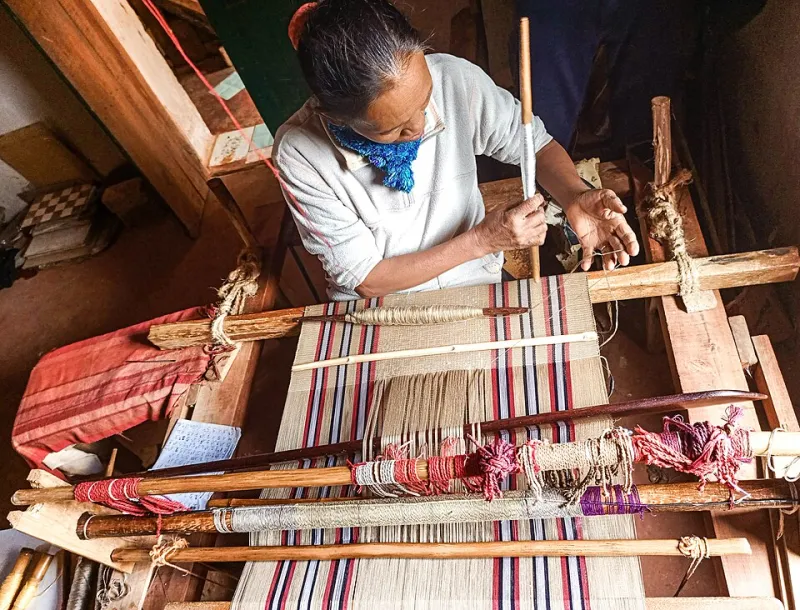
Photo: RAKOTOBLUE, CC BY-SA 4.0, via Wikimedia Commons
There is a particular quality of light that passes through a bolt of hand-woven ikat silk — a luminous, almost breathing quality that no power loom has ever successfully replicated. It is the kind of detail that stops a person mid-step in a showroom, compelling them to reach out and touch something they cannot quite explain. That ineffable quality is precisely what a growing number of luxury fashion houses and independent textile designers are chasing as they look backward across centuries of craft to inform the work they are doing today.
The original Silk Road was never simply a trade route. It was a living corridor of cultural exchange stretching from the imperial courts of China through the bazaars of Samarkand, Persia, and Constantinople, and eventually into the markets of Venice and beyond. The textiles that traveled those routes carried with them not only extraordinary material value but encoded knowledge — pattern vocabularies, dyeing philosophies, and weaving structures that represented generations of accumulated expertise. Much of that knowledge came perilously close to disappearing entirely during the twentieth century, disrupted by industrialization, political upheaval, and the relentless economics of mass production.
What is happening now, in studios from Los Angeles to the historic weaving centers of Central Asia, feels less like a trend and more like a reckoning.
The Artisans Who Kept the Flame
In the ancient city of Margilan, located in the Fergana Valley of Uzbekistan — a region that has been producing silk for more than two millennia — master weavers known as ustods continue to practice a form of silk production that has changed remarkably little since the medieval period. The process begins with hand-reeled thread drawn from silkworm cocoons, continues through a painstaking resist-dyeing method that creates the characteristic blurred, flame-like patterns of genuine ikat, and culminates on wooden looms that require extraordinary physical and intellectual precision to operate.
For decades, this work was sustained almost entirely by local tradition and a small network of international collectors who understood what they were looking at. Today, however, a new generation of Western designers — many of them American — has begun making pilgrimages to these workshops, not to appropriate the aesthetic but to understand it from the inside.
"When you sit with a weaver who has spent forty years perfecting a single category of pattern," notes one New York-based textile designer who has collaborated with Fergana Valley artisans on a recent capsule collection, "you begin to understand that what you are purchasing is not yardage. You are purchasing the distilled attention of a human life."
That perspective is increasingly resonant with American luxury consumers, who have grown sophisticated enough to distinguish between a garment that references heritage and one that genuinely embodies it.
From the Loom to the Lookbook: Collections That Carry History
The commercial expression of this revival is visible across multiple segments of the American luxury market. Established fashion houses have introduced dedicated artisanal lines featuring documented provenance — specific regions, named workshops, identified weavers — as a central part of their brand narrative. Meanwhile, independent designers working within the direct-to-consumer space have built entire identities around the concept of traceable silk, offering customers not just a product but a story with verifiable chapters.
One particularly compelling example is the growing use of Suzhou embroidered silk, a Chinese tradition with roots in the Song Dynasty. Contemporary designers working with Suzhou embroidery studios are commissioning original interpretations of classical motifs — cranes, peonies, cloud formations — and incorporating them into evening wear that is unambiguously modern in silhouette while unmistakably ancient in its surface language. The result is a category of garment that speaks to two audiences simultaneously: the fashion-forward consumer who responds to visual complexity, and the culturally informed buyer who understands the depth behind the imagery.
Similarly, the revival of Jacquard silk weaving traditions rooted in Lyon, France — the city that once supplied silk to the royal courts of Europe — has found an enthusiastic American audience among interior designers and couture clients alike. Contemporary Lyon workshops are producing Jacquard silks that honor eighteenth-century pattern archives while incorporating colorways and scale adjustments suited to contemporary interiors and fashion applications.
Why American Consumers Are Investing in Heritage Silk
The appetite for heritage-rooted luxury goods among American buyers is not incidental. It reflects a broader cultural shift in how this market conceptualizes value. For much of the twentieth century, the dominant American luxury paradigm was aspirational and logo-centric — the brand name was the story. That model has not disappeared, but it has been joined by something more nuanced: a desire for objects that carry genuine intellectual and historical weight.
This shift is particularly evident among buyers in the thirty-five to fifty-five demographic, many of whom have accumulated enough material goods to become discriminating about what they add to their lives. For this consumer, a silk scarf woven on a traditional loom in a workshop with a documented lineage is not merely a beautiful object. It is a form of cultural stewardship — a way of participating, however modestly, in the preservation of something irreplaceable.
At First Silk, we encounter this sensibility regularly among our clients. The questions they ask have evolved. They want to know not only the momme weight and the fiber origin but the weaving tradition a particular textile belongs to, the region it comes from, and whether the artisans involved in its production are compensated in ways that allow the craft to continue.
The Responsibility of Revival
It would be incomplete to discuss this renaissance without acknowledging its complications. The line between respectful engagement with a weaving tradition and the extraction of its aesthetic value without meaningful reciprocity is one that designers and retailers must navigate with genuine care. The most credible participants in this revival are those who have established long-term relationships with artisan communities, contributed to training programs for younger weavers, and structured their commercial arrangements in ways that allow heritage workshops to remain economically viable.
The alternative — licensing the look of a tradition without supporting the people who carry it — produces textiles that are beautiful in a superficial sense but hollow at their core. Discerning buyers, and discerning designers, understand the difference.
A Living Inheritance
The most extraordinary thing about silk as a material is that it has never stopped being extraordinary. For more than five thousand years, human beings have found in this fiber a capacity for beauty that seems to resist exhaustion. The weavers of Margilan and Suzhou and Lyon are not preserving a museum piece. They are continuing a living practice, one that has absorbed and adapted to every era it has passed through.
The designers who are engaging most seriously with these traditions are not engaged in nostalgia. They are making an argument — through their collections, their sourcing decisions, and their narratives — that the future of luxury fashion runs not away from history but deeper into it.
For those of us who work with silk every day, that argument is entirely persuasive.