The Texture Connoisseur: How Affluent Fabric Buyers Are Developing a Sommelier's Palate for Silk
There is a moment, familiar to anyone who has sat across a white-clothed table from a master sommelier, when language and sensation converge into something close to revelation. The wine in the glass is no longer simply red or dry; it becomes an artifact of place, season, and human intention. That same moment is now arriving in the world of luxury textiles—and for those who trade in the finest silks, it is reshaping how fabric is selected, described, and ultimately valued.
Across American design studios, private showrooms, and bespoke fabric consultancies, a growing cohort of trained sensory specialists is applying the vocabulary of the tasting room to the bolt of cloth. These practitioners—some emerging from textile backgrounds, others crossing over from the food and beverage world—are teaching affluent buyers to perceive silk not merely as a surface, but as a story told in fiber, finish, and provenance.
When Terroir Travels to the Loom
The concept of terroir, that French notion that geography and climate imprint themselves upon a product's character, has long been the intellectual cornerstone of fine wine appreciation. What is less commonly understood is how precisely it translates to silk production. The mulberry leaves consumed by Bombyx mori silkworms vary in mineral content, moisture, and cellular structure depending on the region in which they are cultivated. Those variations ripple outward into the fiber itself—affecting luster, tensile strength, and the quality of hand that a discerning buyer can detect through touch alone.
Sensory specialists working in the luxury fabric space have seized upon this parallel with considerable sophistication. Just as a Burgundy enthusiast might distinguish the iron-rich soils of Gevrey-Chambertin from the limestone-heavy terroir of Puligny-Montrachet, a trained silk connoisseur can articulate the difference between the cooler, denser filaments produced in Suzhou's Jiangsu province and the warmer, more luminous threads harvested from the Khotan region of Xinjiang. The geography is different, but the intellectual architecture of appreciation is strikingly similar.
A New Vocabulary for an Ancient Material
Language, as any sommelier will confirm, is the mechanism through which expertise is transferred and perceived value is constructed. The wine world spent decades codifying its descriptive vocabulary—developing shared terms for finish length, tannin structure, acidity, and aromatic complexity—precisely because that shared language made the experience of appreciation communicable and, critically, teachable.
The silk world is now undergoing a parallel codification. Where a wine professional might describe a Barolo as having "grippy tannins with a long, mineral finish," a fabric connoisseur might characterize a 22-momme charmeuse as possessing "a weighted drape with a cool, almost aqueous slip and a finish that softens perceptibly against body heat." The descriptors differ in their specifics, but the underlying ambition is identical: to give buyers a precise, repeatable framework for understanding what they are experiencing.
Terms borrowed from sensory science—mouthfeel's tactile analog, "hand"—are being supplemented with new coinages. Practitioners speak of a fabric's "brightness" (the intensity of its light reflection), its "memory" (how readily it returns to form after compression), and its "warmth register" (the speed at which it responds to skin temperature). These are not arbitrary inventions. They are attempts to make legible what skilled weavers and textile merchants have known intuitively for centuries.
The Ritual as Value Proposition
For luxury retailers and independent fabric houses, the sensory education session is rapidly becoming a powerful commercial instrument. Much as the wine tasting experience transforms a bottle purchase into a memorable occasion—one that buyers associate with pleasure, learning, and social distinction—the guided silk consultation reframes what might otherwise be a commodity transaction.
Consider the contrast. A buyer who selects fabric from a catalog based on color and price point has had a functional experience. A buyer who spends an hour with a sensory specialist, handling weighted samples, learning to distinguish a 4-ply crepe from a satin-back charmeuse by feel alone, and understanding how each fabric's provenance influences its character, has had an encounter. That encounter carries emotional residue. It creates a narrative the buyer can share—at a dinner party, with a client, in the story they tell about the finished garment.
This narrative dimension is not incidental. In the contemporary luxury market, the American affluent consumer is increasingly motivated by experience and knowledge rather than by object alone. The silk itself may be extraordinary, but the understanding of why it is extraordinary—delivered through a structured, expert-guided sensory experience—is what converts a one-time purchase into a sustained relationship with a fabric house.
Training the Hand: What the Process Actually Involves
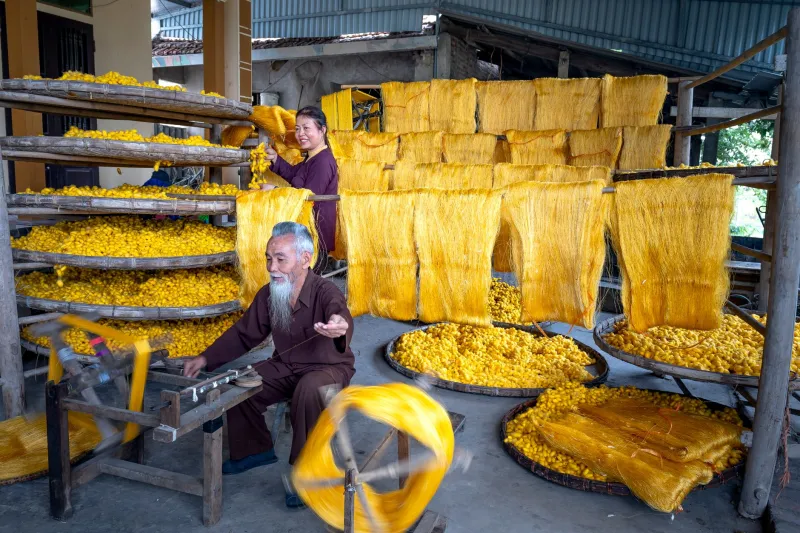
For those curious about what a guided silk tasting session actually entails, the structure is more rigorous than the evocative language might suggest. Sessions typically begin with an orientation to fiber fundamentals: the life cycle of the silkworm, the mechanics of reeling and degumming, the variables that differentiate a wild tussah from a cultivated mulberry silk. This foundational knowledge is the equivalent of a sommelier explaining fermentation before presenting the first glass.
From there, participants progress through a curated sequence of fabric samples, arranged to highlight contrast. A lightweight habotai might be placed alongside a dense, structured dupioni so that buyers can feel, in immediate succession, how weave architecture affects drape and texture. Sensory specialists guide participants through a consistent evaluation sequence—visual assessment of luster and surface uniformity, tactile assessment of hand and weight, and what practitioners sometimes call the "movement test," in which fabric is released from a height to observe how it falls and recovers.
The vocabulary is introduced incrementally, always anchored to the physical sensation it describes. The goal is not to replace intuition but to give it structure—to help buyers trust and articulate what their hands already know.
The Loyalty That Knowledge Builds
Perhaps the most commercially significant outcome of the silk sommelier phenomenon is the loyalty it generates. A buyer who has invested time in developing a sensory vocabulary—who has learned to recognize the particular brightness of a Charmeuse woven from long-filament Mulberry fiber, or the subtle irregularity that marks a genuine hand-loomed Jacquard—does not easily abandon that knowledge. It is tied, inextricably, to the source of their education.
In this sense, the sensory specialist functions not merely as a guide but as an anchor. The fabric house that provides this expertise becomes the buyer's reference point, the institution against which all subsequent textile experiences are measured. That is a position of considerable commercial durability.
For American designers and discerning consumers navigating an increasingly complex luxury fabric market, the emergence of sensory-guided purchasing represents something genuinely valuable: a way to move beyond surface aesthetics and into a deeper, more defensible understanding of what makes a silk extraordinary. The vocabulary of the tasting room, it turns out, was always waiting to describe this ancient, luminous material—someone simply had to begin the translation.