Fabric as Fortune: How America's Wealthiest Families Are Commissioning Bespoke Silk Heirlooms in Place of Fine Art
For decades, the conversation around tangible wealth preservation moved predictably through familiar territory: Old Masters, contemporary canvases, rare wine cellars, and vintage timepieces. The logic was sound — scarcity, craftsmanship, and cultural resonance drove value. Yet a new category has quietly inserted itself into the portfolios and estate plans of America's most financially sophisticated families. Bespoke silk textiles, commissioned as deliberate heirlooms, are emerging as one of the most compelling — and least discussed — repositories of multi-generational value.
This is not a conversation about purchasing a fine silk blouse or even a custom suit length. It is something considerably more intentional: the commissioning of singular, documented, artisan-woven silk pieces designed from inception to outlast their creators, accumulate meaning across decades, and one day transfer to the next generation with the same gravity as a signed painting or a Patek Philippe.
The Investment Logic Behind Woven Luxury
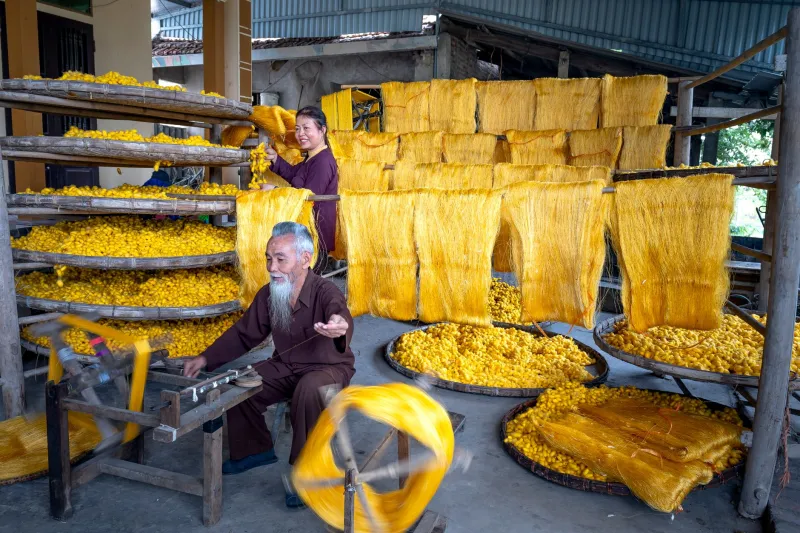
The appeal is easier to understand when framed through the language of scarcity. Genuine handwoven silk — produced on traditional Jacquard or draw looms by master weavers, using cultivated mulberry silk threads dyed with natural mordants — exists in a universe of radical limitation. The number of artisans capable of executing a museum-quality commission at this level shrinks each decade. The looms themselves, many of them antique, require specialized maintenance. The knowledge required to translate a family crest, a botanical motif, or an abstract design into a structurally flawless woven textile is passed through apprenticeship, not textbooks.
When a collector commissions such a piece, they are not simply purchasing fabric. They are purchasing irreproducibility. That quality — the impossibility of exact duplication — is the same engine that drives value in the fine art market. A bespoke silk panel woven in a specific structure, using a specific provenance of thread, by a named artisan working within a documented tradition, cannot be replicated by a mill in 2040 any more than a Flemish tapestry can be reproduced by a contemporary factory.
Financial advisors who work within the family office space are beginning to acknowledge this logic. While silk textiles do not yet appear as a standardized asset class the way art funds or wine indices do, the conversation is opening — particularly among clients who have already maximized traditional collectible categories and are seeking differentiation.
Provenance Documentation and the New Silk Estate
What distinguishes a true heirloom commission from a luxury purchase is the paper trail. Forward-thinking collectors working with bespoke weavers are increasingly requesting comprehensive provenance packages: documented thread sourcing, weave structure diagrams, dye lot records, artisan biographies, photographic records of the loom and production process, and certificates of authenticity co-signed by both the weaving atelier and an independent textile conservator.
Estate attorneys in cities like New York, San Francisco, and Chicago have begun encountering these packages in probate contexts, and several have reported that clients are proactively including silk commissions in formal estate schedules — the same legal documents that enumerate fine art collections, jewelry, and real property. The precedent being set is meaningful: when a textile is treated with the same documentary rigor as a painting, it begins to occupy the same legal and cultural category.
Some families are going further, partnering with textile historians to write formal acquisition narratives — essentially the same kind of catalogue essay that accompanies a museum acquisition — for pieces that will ultimately be stored in archival textile boxes, displayed in climate-controlled rooms, and eventually bequeathed with explicit instructions about conservation and display.
The Cultural Shift: From Decorative to Dynastic
There is a deeper current running beneath the financial calculus. Many of the collectors entering this space are motivated not by return on investment but by a cultural hunger that fine art, for all its prestige, does not fully satisfy. Silk carries a different kind of weight. It is intimate. It has been worn against skin, draped over ceremony, passed through the hands of generations. A painting hangs on a wall; a silk textile lives within a family's story in a more embodied way.
For families with roots in cultures where textile traditions carry deep significance — South Asian, East Asian, Middle Eastern, West African — the commissioning of heirloom silk can feel like a reclamation. It is a way of encoding cultural identity into an object that will persist, that will be touched and recognized by grandchildren who may otherwise have little material connection to a heritage that predates American immigration.
For families without those specific roots, the appeal is equally powerful but differently framed. In a consumer culture that produces and discards at industrial scale, the deliberate creation of something meant to last three generations is itself a countercultural act — a statement about values that no mass-market luxury brand can replicate.
What a Commission Actually Entails
For those considering this path, understanding the process is essential. A serious heirloom silk commission typically begins with a design consultation that may span several months. Motifs are developed in collaboration with the weaver, who advises on structural feasibility and visual impact at scale. Thread selection — weight, twist, origin, finish — is made with both aesthetic and archival longevity in mind. Natural silk dyed with stable, lightfast pigments will hold color across decades in a way that synthetic dyes cannot guarantee.
Production timelines for handwoven commissions are measured in months, sometimes approaching a year for complex Jacquard work. This is not inefficiency; it is the pace at which mastery operates. The resulting piece — whether a large-scale panel, a set of ceremonial cushion covers, a formal table textile, or a length of dress fabric intended to be constructed into a garment and then preserved — arrives with a completeness that machine production cannot approach.
Pricing for commissions of this caliber begins in the mid five figures and can extend considerably higher depending on complexity, scale, and the reputation of the atelier. When measured against comparable fine art acquisitions, the entry point is not unreasonable — and the intimacy of the object arguably exceeds what a canvas can offer.
First Silk and the Discerning Collector
At First Silk, we have long understood that the finest silk is not merely a material — it is a medium. For designers and collectors who are beginning to think about fabric in the same terms they apply to any serious cultural acquisition, the resources required to make informed decisions are not always easy to find. We are committed to providing the editorial depth, sourcing intelligence, and community of expertise that this conversation demands.
The families commissioning silk heirlooms today are not outliers. They are early participants in a broader revaluation of craft, material culture, and the kinds of objects worth preserving. The loom, in this light, is not a relic. It is one of the most sophisticated instruments of lasting value that human hands have ever operated.